
Executive Summary
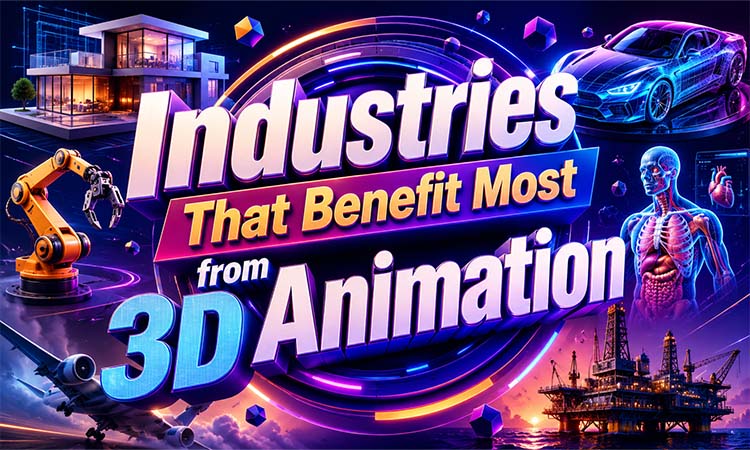
3D animation is a tool for businesses in many industries. It helps explain products show what environments look like train people safely and market experiences. For example manufacturers can reduce the cost of demonstrating their products and sell them faster. Developers can sell properties before they are even built by giving people tours. Healthcare organizations can use animation to help patients understand their treatments better.. Retail businesses can use it to engage with customers and reduce the number of returns.
The best thing about animation is that it can give businesses a really good return on their investment. This happens when sales happen faster training costs are lower customers are more confident and businesses can reuse their animated assets. This guide will look at the industries that use 3D animation the ways they use it the benefits they get from it and the trends that are shaping its adoption in 2026.
What Is 3D Animation?
3D animation is a way of creating experiences using computer-generated models, lighting, movement and effects. It can be used to demonstrate products explain how things work simulate real-life conditions or let people explore spaces. There are tools that can be used to create 3D animations, such as Blender, Maya, 3ds Max, Cinema 4D, Unity, Unreal Engine and CAD software. More and more businesses are using animation for visualization, virtual reality training, advertising, gaming and architecture.
1. Manufacturing and Industrial
Manufacturing businesses can really benefit from animation. This is because their products are often complicated, expensive or unsafe to demonstrate. 3D animation can be used to create equipment explainers, assembly simulations, factory demonstrations, maintenance instructions, training materials and CAD-based visualizations. For example one equipment manufacturer used animation to demonstrate its £50,000 machines instead of showing the real thing. This reduced its sales cycle from 12-16 months to 6-8 months. Saved the company a lot of money. The company even estimated that it made a £400,000 in revenue and saved £200,000 in the first year.
The benefits of animation for manufacturing businesses include shorter sales cycles, fewer prototypes, lower shipping costs, clearer communication and a wider reach. When CAD and animation workflows are used together they can improve accuracy.
2. Architecture and Real Estate
Architects and developers use animation to show people what buildings will look like before they are built. Virtual walkthroughs, flyovers, floor plans and virtual reality tours can help buyers understand the layout, finishes, lighting and surroundings of a property. Properties that are promoted with 3D visualization can sell 20-30% faster. For 3-7% more per square meter. Some developers have even reported a 25-40% growth in pre-sales and shorter sales cycles.
3D animation can reduce uncertainty support investors and accelerate sales. The animated assets can be reused on websites, social media and at exhibitions.
3. Healthcare and Medical
Healthcare organizations use animation to educate patients simulate surgeries, demonstrate anatomy explain medical devices and train staff. Animated videos can improve understanding reduce anxiety and support decisions. Simulations can provide a way to learn without using cadavers, laboratories or live practice.
Medical device companies use animation to communicate with sales teams and regulatory bodies. For example one orthopedic implant company used animation to get approval four months faster which helped it enter the market earlier.
The benefits of animation in healthcare include better comprehension, faster approvals, lower training costs and consistent instruction.
4. Education and E-Learning
3D animation can make abstract subjects more engaging and easier to understand. It is useful for teaching science, engineering, medicine, history, technical training and workplace safety. Applications include laboratories, reconstructions, animated lessons, simulations and virtual reality training. Learners can repeat processes without having to worry about risky environments.
Businesses can use animated modules to reduce travel, instructor time and disruption. For example one manufacturer reported a return on investment, from animated safety training because certifications were faster and incidents decreased. Virtual reality training is really valuable when real-world practice is expensive or hazardous.
5. Entertainment and Gaming
The entertainment industry is still an user of 3D animation. This includes movies, streaming content, games, trailers and virtual reality. All of these things need 3D production to work.
In games players like it when the characters and surroundings look real. It makes the game more fun to play. In movies and television computers can create scenes that would be hard or impossible to make in life.
Even though the return on investment can vary good visuals can help get a response from the audience. It can also help with sharing, brand recognition and sales.
6. Advertising and Marketing
Brands use 3D animation for commercials, launches, explainer videos, social content, mascots, and interactive campaigns.
Animated marketing captures attention and explains benefits clearly. One B2B technology company reportedly increased sales inquiries by 450% after adding 3D explainer videos, while lead conversion rose from 0.8% to 4.4%.
Another retail campaign achieved higher engagement, sales growth, and ROI above 400% through 3D product animation. This explains the importance of 3D Animation in Marketing for product storytelling and premium positioning.
7. Retail and E-Commerce
Retailers use 360-degree models, configurators, animated demonstrations, and AR try-ons to recreate part of the in-store experience online.
In one furniture example, 3D models and AR increased page engagement by 287%, lifted revenue by 156%, and reduced returns from 18% to 7%. Estimated ROI reached 427%.
One 3D model can generate multiple colours, materials, angles, and advertising variations, reducing photography costs while improving buyer confidence.
8. Automotive and Aerospace
Automotive and aerospace companies use 3D animation for virtual prototypes, launches, engineering reviews, assembly training, maintenance simulations, and safety instruction.
They test concepts before production, demonstrate products globally, and train teams without removing costly equipment from service. Reported examples include major reductions in training time for wind-turbine assembly and aircraft maintenance.
Benefits include faster development, lower prototype costs, safer training, and clearer technical communication.
Comparison of Use Cases and Benefits
Manufacturing cuts demonstration costs; real estate accelerates sales; healthcare and education improve learning; marketing and retail raise conversions; automotive and aerospace strengthen development and safety.
FAQ: 3D Animation
Which Industries Benefit Most?
Manufacturing, real estate, healthcare, education, entertainment, marketing, retail, automotive, and aerospace gain the strongest value.
How Does 3D Animation Improve ROI?
It shortens sales cycles, increases conversions, reduces prototypes, lowers training costs, improves retention, and creates reusable content.
Is It Suitable for Small Businesses?
Yes. One animation can support websites, social media, presentations, advertisements, and training, making the investment cost-effective.
How Should Results Be Measured?
Track sales-cycle length, conversions, engagement, training time, returns, demonstration costs, approvals, and customer feedback.
Conclusion and Future Trends
3D animation is no longer limited to films and games. It is now a strategic communication, sales, design, and training asset. Businesses use it to explain complex ideas, reduce costs, improve experiences, and generate measurable returns.
The next stage will be shaped by real-time engines, AR, VR, and AI-assisted production. These technologies will make animation faster, more interactive, and accessible. Organizations investing early in 3D animation use cases will be better positioned to innovate, communicate clearly, and compete in visual markets.