
Difference between 2D and 3D Animation
Executive summary
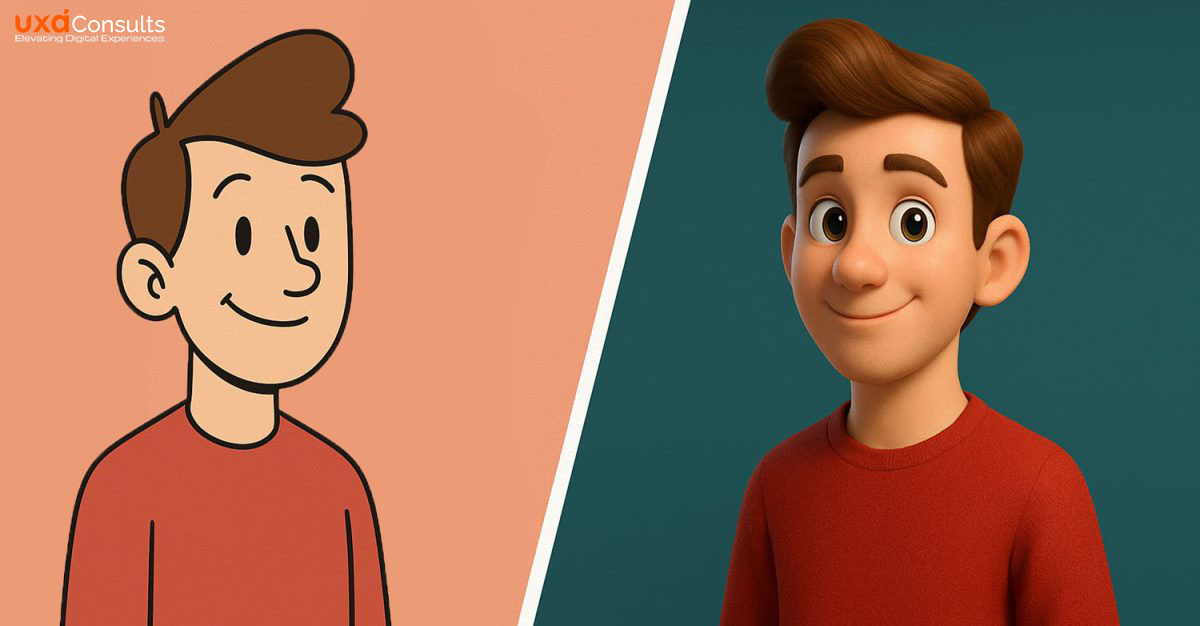
The biggest difference between 2D animation and 3D animation is that 3D animation has depth. 2D animation is made with pictures that only have height and width but 3D animation uses objects that have height, width and depth. These 3D objects can be made to look like things and they can be moved and shown from different angles.
Both 2D animation and 3D animation have the basic steps to make them, which are getting ready making it and finishing it. However 3D animation has some steps, like making the objects adding details to them setting them up to move adding light and making the final pictures.
From my point of view this is not really about which one is better, 2D or 3D. It is about what works. I think 2D is usually the way to go for things like explainers, stories in newspapers and fancy ads. It is also good for making games because it is easy to see what is going on and it does not cost much to get started.
2D is also good because it is straightforward and does not take long to make. On the hand 3D is better when you want things to look real like when you are showing off a product or making a movie with cool camera moves or telling a story that needs to feel like it is really happening in a place. The people who make these things they charge more for 3D. It takes longer at first but it can be worth it if you need to use the same things over and over again.
What 2D and 3D animation are
When I try to explain what 2D and 3D animation are I keep it simple. 2D animation is like a drawing it is flat. And 3D animation is like a thing it has depth. Animation is like a trick it makes things look like they are moving. It does this by showing a lot of pictures in a row. In 2D animation these pictures are flat like a piece of paper. In animation these pictures are, like objects that you can pick up and move around they can be lit up and filmed like real things.
The main difference between these two styles affects a lot of things: what they look like how they are made the software used, the cost and the type of stories they tell. For me 2D animation is about design. It is about the shapes, how things are put together the colors, the timing and how clear the pictures are. 3D animation is about the space. It is about how things take up room the lighting what they are made of, how the camera moves and how things move in a way that looks real. One way is not better than the other they just solve problems.
Brief history
The history of 2D animation is closely tied to drawing and using cells. If you look it up you will find that cel animation let people draw moving figures, on sheets and put them over a background that does not move which made it easier to make cartoons and let studios add more details to the background. In mainstream film history, a major milestone came in 1937, Walt DisneyStudio identifies Snow White and the Seven Dwarfs as the studio’s first fully animated feature film and a pioneering step in the medium’s growth.
3D animation grew out of computer graphics research. A describes the 1972 short by Edwin Catmull and Fred Parke as an early landmark in computer animation. By 1995, states that Toy Story became the world’s first computer-animated feature film. So, while 2D has a longer industrial history, 3D is not “new” in any meaningful sense; it is the result of decades of graphics research, software development, and production experimentation.
How the production process changes
The two styles share the same big production phases: pre-production, production, and post-production.Animation is broken down into planning and scripting, visual development and storyboarding, production work, final sound, and delivery in a current pipeline guide from CG Spectrum. This high-level structure is helpful because it illustrates how 2D and 3D are not entirely distinct worlds; rather, they diverge primarily in the middle of the pipeline, which is typically built around layout, design, frame-by-frame animation, cut-out animation, in-betweening, coloring, compositing, and final render/output in 2D. This high-level structure is helpful since it illustrates how 2D and 3D split primarily in the middle of the pipeline rather than being entirely distinct worlds.
Layout, design, frame-by-frame animation, cut-out animation, in-betweening, coloring, compositing, and final render/output are often the main components of the middle phase in 2D. Toon Boom’s training material describes cut-out animation as breaking a puppet into pieces and moving those parts frame by frame, while the company’s official Harmony page presents its software as an end-to-end 2D production tool linked with storyboarding and layout. For me, that is the essence of 2D workflow: the team is mainly controlling drawings, shapes, and poses.
In 3D, production becomes more technical because the team first has to build the objects being animated. Autodesk’s Maya documentation lays out the typical stages clearly: modelling, rigging and animation, simulation/effects, look development, and rendering. Autodesk’s rigging guide explains that skeletal rigs create an internal bone structure with IK and FK controls so animators can move a model naturally. In practice, that means 3D teams spend a lot of time preparing digital assets before the final movement even begins. That extra preparation is one of the main reasons 3D often takes longer up front.
Tools, costs and common use cases
The software landscape reflects those different needs. On the 2D side, widely used choices include Harmony for end-to-end character animation, After Effects for motion design and compositing, Blender’s Grease Pencil for 2D work inside a 3D environment, and Unity’s 2D toolset for sprite, rigging, skinning, IK, lighting, and tilemap-based game workflows. On the 3D side, common choices include Maya, Blender, Cinema 4D, Houdini, and Unreal Engine for real-time 3D creation. I would describe this split like this: 2D tools are usually strongest at drawing and graphic motion, while 3D tools are strongest at building, animating, and rendering worlds and objects in space.
Cost is where many readers focus first, but the research suggests a more nuanced answer than “2D is cheap, 3D is expensive”. Studio guides still broadly show 3D as the pricier route for comparable work because of modelling, texturing, rigging, lighting, and rendering. One guide from ROUGE Collective puts comparable 3D projects at roughly 20% to 40% higher upfront than 2D, and Pixune’s commercial benchmarks place many 2D explainers around US$2,000–15,000+ per minute and many 3D projects from roughly US$5,000–25,000+ per minute, with higher-end 3D often going well beyond that. At the same time, both sources note that reuse changes the equation: a simple 3D product spin can be cheaper than a heavily hand-drawn 2D narrative, and reusable 3D assets may reduce marginal cost across later shots, edits, or sequels.
Timelines show a pattern. A recent guide from Hocus Pocus Studio says a typical 30-60 second 2D explainer video takes around four to six weeks to make. A one-minute 3D animation takes around eight to twelve weeks. Media Village gives an idea saying many 2D jobs take two to four weeks and many 3D projects take four to eight weeks. It all depends on how complex the project is how much feedback is needed.
So my own planning rule is simple. If the project brief is short explanatory and has a deadline I would test 2D animation first. 2D animation is good for projects. If the brief needs images, accurate spaces or reusable assets I would price 3D animation before ruling it out.
2D animation is good for projects. These include explainer videos, educational content and news stories. It is also good for adverts, TV graphics and many 2D games. This is because 2D animation is easy to read, friendly to brands and uses visuals efficiently.
On the other hand , 3D animation is often better for other projects. These include product visualisation, walkthroughs of buildings and technical demonstrations. It is also good for demonstrations, film and visual effects and immersive experiences. This is because 3D animation handles shapes, materials, sizes and camera movements naturally. That is why I think of 2D animation as 3D animation as rich in information about space.
How I choose between them
When it comes to deciding between 2D and 3D for an article or business brief I think about a few things. What do the people reading this need to get out of it? Does the message need to look really real. Is it just about being clear? Will I need to use these pictures or videos later? How time do I really have to make this?
If the main goal is to explain something in an fast way I think 2D is usually the way to go. But if the people reading this need to look at a product understand how something moves or feel like they are right there in the scene then 3D is usually worth the extra work.
My own way of thinking about this is pretty simple: I choose 2D when I need to get a point across I choose 3D when I need to create a sense of space and I think about using a mix of both when I need some depth without making a 3D project. This matters because the tools we use are getting better at combining 2D and 3D elements. For example After Effects can mix 2D and 3D things Blender can do 3D work and 2D drawing and the prices that studios charge are starting to show that using a mix of 2D and 3D is a middle ground, between making a big impact and keeping costs down.